


- Blog Post
Are You Responsible for the Calibration of Temperature Sensors in a GxP Environment?
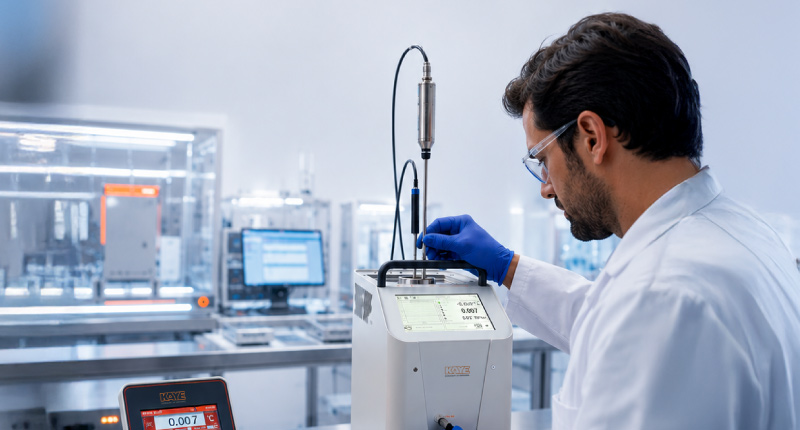
If calibration sits on your scope of responsibility, you already know it rarely stays a simple, routine task. In a GxP environment, calibration quickly becomes a question of data integrity, audit readiness, and ultimately, product quality. At first glance, verifying a temperature sensor may seem procedural. In practice, it carries far more weight. Every recorded value feeds into validation decisions, batch release, and compliance evidence. When that data is questioned, the impact extends far beyond a single instrument.
Temperature sensor calibration in a GxP context is a controlled and documented process in which a device under test is compared against a traceable reference standard across defined calibration points to quantify measurement deviation, verify performance within specified tolerances, and maintain data integrity for regulated processes.
This approach requires traceability to recognized standards such as ISO/IEC 17025, defined measurement uncertainty, and multi-point verification aligned to actual operating ranges. It also includes documenting as-found and as-left conditions to support impact assessment and audit readiness.
In validation environments, this process underpins data defensibility, regulatory compliance, and product quality decisions.
What Are You Actually Responsible For?
Temperature calibration is not just about checking whether a sensor works. It is a metrologically controlled comparison between a device under test and a traceable reference standard. This comparison is performed across defined calibration points to verify accuracy, linearity, and measurement uncertainty within specified tolerances. That distinction is critical in practice. Calibration does not improve intrinsic sensor accuracy. It quantifies deviation and indicates whether the instrument remains within its validated state.
In regulated environments, traceability must extend through an unbroken chain to national or international standards, typically under ISO/IEC 17025 accreditation. This includes defined uncertainty budgets, documented calibration procedures, and controlled environmental conditions.
Multi-point calibration is not arbitrary. It is designed to characterize sensor behaviour across its operating range, typically using three or more points aligned to actual process conditions. This approach verifies accuracy at setpoints and exposes non-linearity, hysteresis effects, and localized drift.
Why Calibration Is Non-Negotiable in GxP Environments
Regulatory expectations are prescriptive at the control level. Frameworks such as EU Annex 11 and GxP guidance require that instruments used in GMP, GLP, and GDP activities to be calibrated against traceable standards with defined maximum permissible error (MPE) and documented uncertainty.
During inspections, auditors assess evidence, not intent. This includes complete calibration records, traceability chains to national standards, defined uncertainty statements, and controlled data retention with secure, time-stamped audit trails. Retrieval of historical certificates and raw calibration data over multi-year periods is routinely requested. From a product quality standpoint, temperature measurement error propagates directly into process parameters. Small deviations can shift lethality calculations, alter stability profiles, or move storage conditions outside qualified ranges for biologics and vaccines.
Data integrity requirements extend further. Calibration status, correction factors, and uncertainty must be reflected in validation datasets and environmental monitoring records. Under ALCOA++ principles, any gap in calibration traceability or data lineage can invalidate study outcomes, impact batch disposition, and trigger deviation or requalification activities.
The Hidden Challenge: Sensor Drift and Measurement Uncertainty
Even high-quality sensors are not static. Over time, they drift due to material degradation, thermal cycling, mechanical stress, and environmental exposure. From a metrology perspective, drift directly impacts measurement uncertainty. In validation, uncertainty defines the confidence interval of the data rather than remaining a purely theoretical parameter.
Different sensor technologies exhibit distinct drift characteristics.
Platinum RTDs are valued for long-term stability, typically drifting less than 0.1°C per year under controlled conditions.
Thermocouples offer a wider temperature range but are more susceptible to drift due to oxidation, contamination, and junction degradation, particularly at elevated temperatures.
Thermistors provide high sensitivity but can exhibit non-linear drift behaviour outside their optimal range.
In high-impact applications such as sterilization, depyrogenation, or cold chain validation, even small deviations can distort heat distribution profiles. They can also mask worst-case conditions. Over time, this creates a disconnect between actual process performance and documented validation data.
If left unmanaged, drift introduces error and weakens data defensibility.
What Does a Robust Calibration Process Actually Look Like?
A compliant calibration process is built around controlled conditions, defined procedures, and quantified uncertainty. Sensors are exposed to highly stable thermal environments using dry block calibrators or liquid calibration baths. These systems typically operate with uniformity and stability within ±0.01 to ±0.05°C, depending on the system class. The device under test is then compared against a reference standard with a significantly lower uncertainty ratio, establishing metrological validity.
Equilibration time is a critical but often underestimated factor. Sensors need to reach thermal stability before measurements are recorded, particularly in multi-point calibrations where gradients and thermal lag introduce error.
Results are documented in two stages. The as-found condition captures the pre-calibration state, which is essential for impact assessment in case of out-of-tolerance conditions. Following adjustment, the as-left condition verifies that the instrument has been restored within specification.
Advanced calibration workflows also account for:
- Measurement uncertainty budgets
- Correction factors and offsets
- Hysteresis evaluation during increasing and decreasing temperature cycles
- Repeatability across multiple runs
Calibration strategies vary based on application risk. Laboratory calibration provides controlled conditions and lower uncertainty, while in-situ calibration reduces process disruption but may introduce higher uncertainty due to environmental variability. Regardless of method, documentation needs to be audit-ready. This includes calibration certificates, traceability chains, environmental conditions, reference standards used, and full data records aligned with 21 CFR Part 11 requirements.
Where Traditional Calibration Approaches Fall Short
Despite well-defined procedures, practical execution often introduces variability at multiple levels. Manual sensor handling can lead to inconsistent immersion depth, positioning errors, and poor thermal contact. Each of these directly affects measurement accuracy. In dry block systems without proper insert matching, air gaps can introduce additional uncertainty. Limited temperature coverage restricts the ability to replicate real process conditions. This becomes more critical in applications spanning sub-zero storage to high-temperature sterilization. The result is a gap between calibration data and actual validation requirements.
Equally critical is the lack of integrated uncertainty management. Many conventional approaches focus on pass or fail criteria without fully quantifying uncertainty contributions from the reference, environment, and measurement system. Documentation is another common failure point. Fragmented data capture, manual record keeping, and lack of audit trails increase compliance risk, particularly under regulatory scrutiny.
In high-throughput validation environments, these limitations translate into repeated studies. They also extend deviation investigations and reduce confidence in measurement data.
How Kaye Calibration Solutions Support Your Daily Work
Kaye calibration dry block and calibration bath solutions deliver high accuracy and repeatability across a wide temperature range, from -90°C to +420°C, with extended capability down to -196°C for specialized applications.
At the reference level, the Kaye IRTD 400 temperature standard probe provides a high-accuracy, traceable reference with a well-defined uncertainty profile, enabling reliable comparison against the device under test and strengthening metrological confidence during calibration. Kaye dry block calibrators and liquid calibration baths establish stable thermal environments with tight uniformity and stability, allowing controlled and automated multi-point calibration across the required operating range. Proper insert design and immersion control reduce air gaps and thermal gradients, improving measurement consistency compared to conventional setups.
For temporary capacity expansion, shutdown support, or unexpected validation demands, Kaye also offers short-term and long-term rental options for validation equipments, including LTR and HTR dry block temperature calibrators, allowing teams to maintain calibration continuity without disrupting qualification schedules.
Automation standardizes the calibration workflow. It reduces operator dependency, controls equilibration timing, and ensures repeatable execution across cycles. This directly improves data consistency and reduces variability between calibration runs. Integrated data handling captures and structures calibration results in real time, including as-found and as-left data, correction factors, and traceability records. This supports audit readiness and eliminates gaps associated with manual documentation.
Traceable temperature standards anchor the entire process, maintaining compliance and ensuring that calibration results remain defensible under regulatory scrutiny.
Conclusion
When calibration is approached systematically, it evolves from a periodic task into a controlled process within the broader validation lifecycle, where consistent calibration practices feed into qualification, routine monitoring, and continued verification while establishing a direct link between measurement accuracy and process reliability. In this context, calibration does not operate as an isolated activity but functions as a control point that reinforces overall system integrity, ensuring that measurement data remains consistent, traceable, and defensible across validation stages.
In GxP environments, calibration is fundamentally about control and confidence, control over measurement accuracy and confidence that the data supporting critical decisions will withstand scrutiny. The difference lies not only in performing calibration, but in the consistency and repeatability of its execution.
If you are responsible for calibration in your organization, it is worth evaluating whether your current approach supports the required level of compliance and operational efficiency.
Explore how Kaye calibration solutions can support your process, Schedule a demo or connect with a certified Kaye partner