


- Blog Post
What Added Value Does Real-Time Data Logging Deliver? The Modern Validation Standard
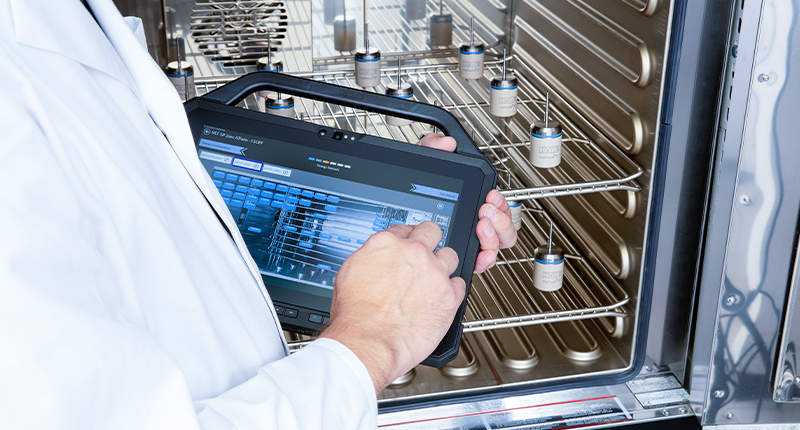
In many pharmaceutical and biotech facilities, validation teams still rely on conventional data loggers paired with reader stations. The logic is familiar. If a system has worked reliably for years, it feels sufficient. However, this assumption often conceals inefficiencies that only surface when teams compare legacy workflows with modern, real-time validation systems.
This article explores how real-time data logging reshapes validation activities in regulated environments. It examines operational workflows, risk exposure, time efficiency, and decision-making quality, while placing these changes in the context of pharmaceutical validation, cleanroom compliance, and thermally demanding processes where accuracy and reliability are critical.
The Traditional Logger Reality
Before a validation run begins, conventional data loggers demand extensive preparation. Configuration data must be transferred from a laptop to each individual logger using a reader station. When a validation requires dozens of sensors, this task becomes a bottleneck that consumes both time and skilled resources.
After the validation system starts, uncertainty becomes part of the process. Teams can only assume that each logger has started correctly and will continue recording for the full cycle. Critical risks remain invisible until the very end.
Typical unanswered questions include:
- Did all loggers actually start recording at the correct moment?
- Are timestamps synchronized across devices?
- Will battery capacity last through the full exposure cycle?
- Are temperature and pressure values remaining within defined limits?
The answers only appear after the process completes, loggers are removed, and data is read out again through the reader station. If even one logger fails, the entire validation run may need to be repeated. The result is lost time, extended equipment downtime, and additional strain on production schedules.
How Real-Time Logging Changes the Equation
Real-time validation systems fundamentally alter this workflow. Loggers are activated directly, removing the need for lengthy pre-configuration via reader stations. Before installation, the system evaluates battery status across all devices, giving teams confidence that every logger can complete the upcoming run.
Once installed, each logger can be assigned to a defined mapping position. This step is more than administrative. It allows validation engineers to see exactly where each measurement point is located and how conditions evolve across the chamber or process area in real time.
Recording parameters are transmitted wirelessly and confirmed before the run begins. When the validation process starts, all measurement data becomes immediately visible through a centralized console. There is no waiting period and no assumption-based monitoring.
Validation teams gain live access to:
- Temperature and pressure values as they develop
- Transmission quality and radio signal strength
- Battery performance throughout the cycle
- Data completeness for each logger, including transmission progress and confirmation of received data volume
This information can be displayed as structured lists, graphical maps, or detailed tables, allowing teams to verify stability while the process is still running.
Operational Control During the Run
The most significant shift introduced by real-time logging is operational control. Deviations no longer remain hidden until post-processing. If a temperature profile drifts, pressure behaviour changes, or a device stops transmitting, teams can identify the issue immediately.
This visibility enables informed decisions during the run itself. Validation engineers can choose to abort a process early, adjust schedules, or notify production teams with confidence about when operations can safely resume. In long or high-value cycles involving heat, pressure, and extended exposure times, this capability can prevent hours of unnecessary downtime.
The longer and more complex the validation, the greater the benefit. Real-time data transforms validation from a reactive exercise into a controlled, decision-driven activity.
Faster Completion and Flexible Reporting
After the validation run concludes, stopping the recording process is straightforward. Any remaining data is automatically transmitted to the base station and stored securely. Compared to reader-based systems, preparation and readout times are significantly reduced.
Another advantage is flexibility. In addition, real-time systems allow validation teams to run parallel validation activities using the same platform. While not all runs may require live monitoring, teams can manage multiple processes concurrently or use additional base stations where real-time visibility is required.
Reports do not need to be generated immediately after data collection. Validation teams already know whether the run was successful, allowing reporting to be scheduled at a more convenient time without delaying production decisions.
Technology Advantages That Matter
Modern real-time validation platforms deliver value beyond live data visibility. Key technical advantages include:
- True real-time data transmission without delayed synchronization
- Intelligent battery evaluation that predicts runtime reliably
- Optimized energy consumption through smart standby and transmission control
- Reduced long-term battery costs due to efficient power usage
- Strong and stable radio performance in challenging environments
These characteristics are particularly important in applications that involve repeated thermal stress, pressure changes, and metallic enclosures, where signal reliability and device robustness directly influence data integrity.
Kaye's Leadership in Real-Time Validation
With more than six decades of experience supporting regulated industries, Kaye Instruments has developed its validation technologies around the realities of pharmaceutical and biotech operations. The focus extends beyond data recording to delivering reliable, real-time insight that enables controlled, evidence-based decisions while validation activities are actively underway.
Core real-time validation solutions within the Kaye portfolio include:
- ValProbe RT System with Base Station, delivering true real-time temperature and pressure validation through a single, integrated platform with centralized control and live data transmission
- ValProbe RT Data Loggers, available in a wide range of temperature and pressure variants to support diverse validation scenarios and challenging process conditions
- Common Reporting and Analysis Software, enabling standardized reporting, data integrity, audit readiness, and consistent workflows across applications
These solutions are widely applied in sterilization, depyrogenation, and freeze drying workflows, where measurement reliability, traceability, and process control are critical to compliance and operational continuity.
This design philosophy reflects established regulatory expectations. Validation data must be accurate, traceable, and available when decisions matter.
The Real Business Impact
Quantifying the value of real-time validation in a single metric is difficult. However, the operational impact is clear. Reduced preparation time, fewer failed validation runs, and minimized production downtime translate directly into cost savings and improved resource utilization.
More importantly, real-time logging changes how validation teams work. Uncertainty is replaced with visibility. Reactive troubleshooting gives way to proactive control.
Key Takeaways for Modern Validation
For organizations evaluating their validation strategy, several points stand out:
- Real-time data reduces operational risk during critical processes
- Live visibility enables faster, better-informed decisions
- Validation efficiency improves without compromising compliance
- Data loggers designed for demanding environments deliver greater long-term reliability
These factors collectively support stronger validation outcomes and more predictable operations.
Conclusion
Real-time data logging represents a shift in how validation is planned, executed, and evaluated. It moves validation away from assumption-based workflows toward continuous visibility and control.
As regulated industries face increasing pressure to optimize efficiency while maintaining compliance, systems that provide insight during the process, rather than only after completion, are becoming essential. Real-time validation does not replace regulatory rigor. It reinforces it by reducing uncertainty, strengthening confidence, and enabling better decisions across the validation lifecycle.
Frequently Asked Questions
What is the primary advantage of real-time data logging in validation?
The primary advantage is continuous visibility while the process is running. Validation teams can confirm correct execution, detect deviations early, and take informed, timely decisions before a validation cycle concludes, rather than relying solely on post-run analysis.
How does real-time data logging support autoclave validation?
Real-time validation provides visibility into temperature and pressure behavior while the cycle is running, allowing teams to confirm correct execution and maintain control in high-temperature, high-pressure processes.
Does real-time logging replace traditional validation reporting?
No. It complements reporting by ensuring that data quality and process outcomes are already understood before formal reports are generated.
How does real-time logging impact downtime?
By enabling early detection of issues, real-time logging helps prevent unnecessary continuation of failed runs, which can significantly reduce unplanned downtime.
Can real-time systems support regulatory compliance?
Yes. When implemented correctly, real-time validation systems support data integrity, traceability, and audit readiness, aligning with regulatory expectations.
Copyright: Amphenol Corporation